Loading the deck…
1. Deal the incident and causes
Use one laptop as the table recorder. Record the draw; keep private ballots off the shared screen. The active 40-minute route allows redraws, several drafting turns, oral reading and card ranks.
Record the final causes before collecting ranks. If a cause is too hard to connect to the incident, discard it and draw another.
Recorder's private draw and argument labels
For a physical deal, set the cause IDs and argument labels above before collecting ballots. Share each cause privately. Read each final paragraph aloud; rate only after all have been heard.
2. Copy a prompt into your organisation’s approved chatbot
Work back and forth as needed. Read the final paragraphs aloud, then save independent ranks before displaying scores. Existing chatbots are used by copy/paste; this page makes no AI calls.
3. Enter locked private ranks
Each person uses every rank once, including for their own paragraph. 1 = most persuasive. Collect every private ballot before entering them here.
This compares each writer’s rank with peers’ mean rank of that same paragraph. It cannot isolate AI's effect, measure belief change or identify the true cause. Keep separate rounds separate. Rules and scoring
4. Compare your rank with peers
For your own paragraph, compare your rank with the other people’s mean rank of the same paragraph. Lower numbers mean greater preference. Discuss the actual pattern; a convincing paragraph does not establish its cause.
Session data stays in this browser's local storage. Download it before switching devices. This is a table recorder, without shared rooms.
Review the card designs
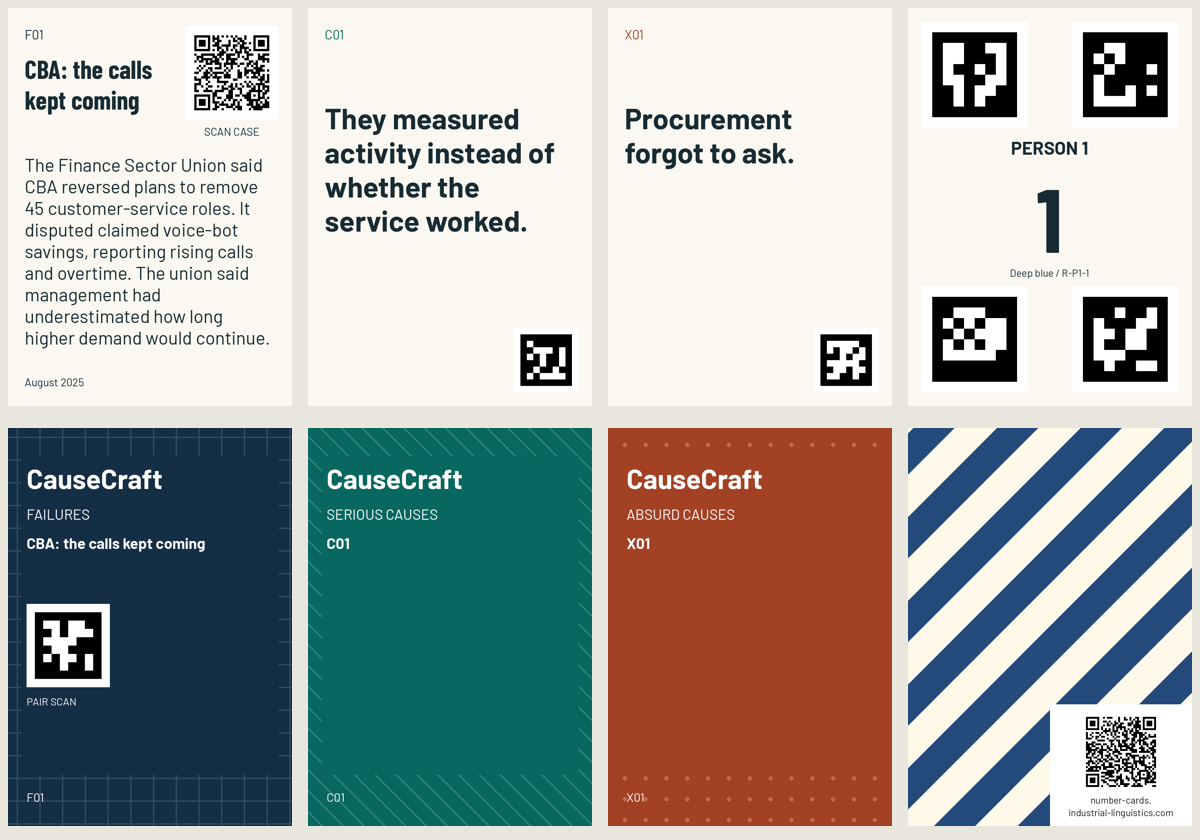
5 incidents · 30 serious causes · 15 absurd causes · 125 personal number cards. Each of 25 people keeps a set numbered 1–5, with its own back colour. Cause fronts show the reason, ID and a small AprilTag. Flip a preview to see its back.
Reported causes and missing evidence
Selected case notes with sources · Download research in Markdown
Print the cards
Use one number set for the whole room and five copies of each failure, one per table. The two-copy cause pack has two of each design. Jumbo failures use a separate MPC project from poker cards.
- 125 number cards · actual-size A4 PDF · MPC ZIP
- Two of each cause · 90 poker cards · PDF · MPC ZIP
- Five table kits · 250 poker cards · PDF · MPC ZIP
- 25 jumbo failure cards · actual-size A4 PDF · MPC ZIP
- Five cause decks · 225 poker cards · MPC ZIP
- Everything together · 375 poker cards · MPC ZIP
- Shared cause deck · 195 poker cards · MPC ZIP
- Shared cause deck plus numbers · 170 poker cards · MPC ZIP
- One of every design · 175 cards · A4 proof
- Private ballot · print one per person
- Rules, printing and scan instructions
Print PDFs at 100% / actual size, A4, double-sided with long-edge flip. Measure the 50 mm ruler and check front/back alignment before cutting. Number-card backs are plain person colours; show the four-tag front to the camera.
For MPC, use Traditional 2.5 × 3.5-inch poker cards, or 3.5 × 5.75-inch large cards for the jumbo failure ZIP. Each ZIP includes its paired PNGs, manifest and upload order. Review the manufacturer's preview before ordering. The number cards come from the separate reusable Number Cards repository. No shopfront listing or manufacturer order is involved.
Put two card tags in the frame
Show the back of one poker-size failure and the front of one cause, with both AprilTags visible. For jumbo failures, open the incident page using the front QR. For earlier printings, use the tag or match the cause text. Some older cards carry the tag on the back. Confirm the identified pair, then copy the combined prompt. Photos and camera frames are processed here on your device.
Manual failure/cause selection is always available in Play. Physical scanning still needs rehearsal with the chosen printer and room lighting.
Use Scan number cards (experimental) to collect room responses from overlapping photographs. For CauseCraft ballots, record the argument and round separately; a card cannot identify the argument by itself.
Read number cards across the room
Give each person their own set of five cards. For one question, everyone holds one number steady while you photograph the room. Add overlapping photos to the same sweep. One readable corner identifies the person and number; extra corners and repeat photographs count once.
Photographs stay on this device. Only decoded responses are saved in this browser; photographs are not retained.
If two different numbers are read for one person, check with them and resolve the conflict. Missing people remain missing. Start a new sweep for the next question or round.
Use the person number to distinguish similar colours. Camera distance, focus, fingers and lighting still need a trial with printed cards; unread corners cannot be recovered from the colour alone. For CauseCraft ranking, keep private ballots private until all ranks are saved.