How to play
Rules
Argue the cause you were dealt as persuasively as you can, without inventing anything. Then find out whether the table agreed with you.
You will need
- Three to five people at a table.
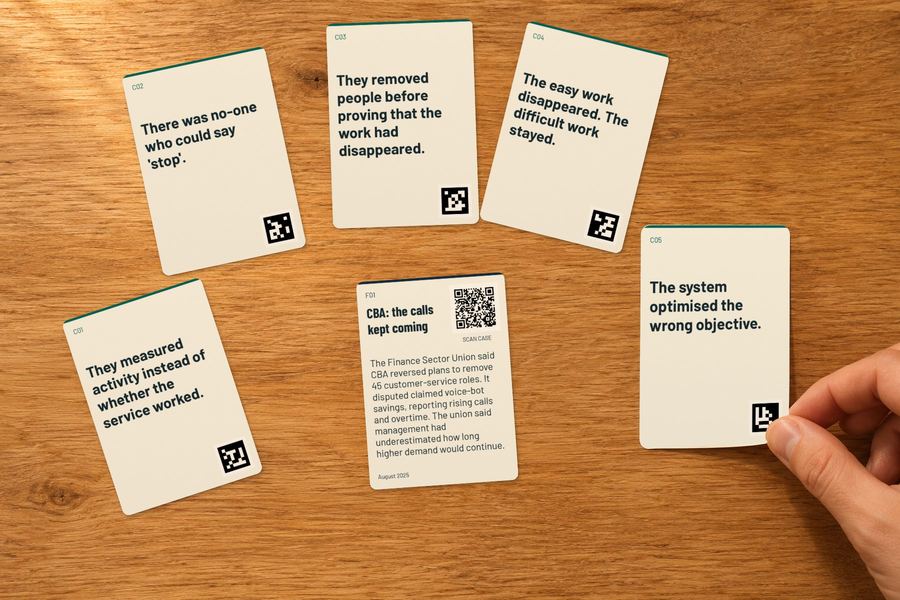
- One failure card for the table, and the deck of serious cause cards.
- A phone or laptop for each person, with your organisation’s approved chatbot.
- A private ballot for each person, or a pen and paper.
- Optionally, one laptop running the table recorder to deal causes, collect ranks and do the arithmetic.
One round, step by step
1. Deal · 5 minutes
Turn over one failure card for the table and read it aloud. Deal one serious cause card to each person, face down. That is the explanation you will argue, whether or not you believe it.
If a cause is too hard to connect to the incident, discard it and draw another. Once everyone is happy, the recorder notes which cause each person holds.
2. Draft · 12 minutes
Scan the QR code on the failure card, choose or scan your cause, and copy the combined prompt into your organisation’s approved chatbot. The prompt already contains the incident, its sources and your cause.
Work back and forth with the chatbot until you have one persuasive paragraph of 100–140 words. Keep the reported facts as reported. You may argue and interpret, but do not invent figures, quotations, sources, meetings or motives.
For five example paragraphs, including one that breaks this rule, try the sample round.
3. Read · 8 minutes
The recorder gives each paragraph a letter, A to E. Each person reads their paragraph aloud. Nobody shows a rating or a reaction until every paragraph has been heard.
4. Rank · 8 minutes
On your own ballot, rank every paragraph from 1 (most persuasive) to the last, including your own. Use each rank once. Hand in every ballot before anyone sees a score.
5. Discuss · 7 minutes
Reveal the scores. Look first at the peer leaderboard, then at the gap between how each writer ranked their own paragraph and how the others ranked it. Then ask whether the winning paragraph was right, or only persuasive. Debrief questions
Scoring
- With N people, a rank of 1 earns N−1 points and the last rank earns 0.
- The peer score leaves out the writer’s vote for their own paragraph, so nobody can vote themselves to victory. Equal scores stay tied.
- Each writer’s self-preference is the others’ average rank for their paragraph minus the rank they gave it themselves. A positive number means you liked your paragraph more than the table did.
- A table with a missing or repeated rank gets no leaderboard until the ballots are corrected.
A worked example
An invented table of five plays the CBA incident. Person 1 wrote paragraph A, person 2 wrote B, and so on. Each row is one person’s ballot; the shaded cell is their rank for their own paragraph.
| Ballot | A | B | C | D | E |
|---|---|---|---|---|---|
| Person 1 | 1 | 3 | 2 | 5 | 4 |
| Person 2 | 3 | 1 | 2 | 4 | 5 |
| Person 3 | 2 | 4 | 1 | 3 | 5 |
| Person 4 | 1 | 3 | 2 | 4 | 5 |
| Person 5 | 2 | 4 | 3 | 5 | 1 |
| Paragraph | Cause argued | Peer points | Writer’s own rank | Others’ average rank | Self-preference |
|---|---|---|---|---|---|
| A | They measured activity instead of whether the service worked. | 12 | 1 | 2 | 1 |
| C | They removed people before proving that the work had disappeared. | 11 | 1 | 2.25 | 1.25 |
| B | There was no-one who could say 'stop'. | 6 | 1 | 3.5 | 2.5 |
| D | The easy work disappeared. The difficult work stayed. | 3 | 4 | 4.25 | 0.25 |
| E | The system optimised the wrong objective. | 1 | 1 | 4.75 | 3.75 |
Paragraph A wins with 12 peer points. Four of the five writers ranked their own paragraph first. The writer of E is the outlier: they ranked their paragraph first, but the others gave it an average rank of 4.75, a self-preference of 3.75. The writer of D was the only one who did not rank their own paragraph first, and their gap is the smallest. Across the table the average self-preference is 1.75 places.
The table recorder does this arithmetic for you and also exports the raw ranks as a spreadsheet.
The absurd round
The absurd cause cards, such as “The project was cursed”, make a lighter bonus round. Play it as a separate round and keep its scores separate. Treat each joke as a metaphor for something about the system or the organisation, and keep the reported facts intact.
Printing the cards? See Get the cards. Card sizes, bleed and upload order are in the production specification.